


12 Best Games for Networking Events That Work
A room full of capable people can still feel awkward when nobody knows where to begin. The best games for networking events give guests a natural reason to approach someone, share a laugh and start a conversation that does not feel like a sales pitch. The aim is not to force fun. It is to make meeting people easier.
For corporate socials, conferences, trade shows and client evenings, choose activities that are simple to join, easy to leave and enjoyable for people with different confidence levels. A great networking game creates small moments of connection while leaving plenty of space for proper conversation.
What makes a networking game work?
The strongest activities have a low barrier to entry. Guests should understand what to do in seconds, without a lengthy briefing or specialist skill. They also need to support short interactions. At a busy event, people may have ten minutes between sessions or want to speak to several new contacts.
Avoid games that eliminate people early, require teams to know one another in advance or demand everyone’s full attention at once. Competitive energy can be brilliant, but it should stay light. The goal is to create a welcoming atmosphere where newcomers and experienced networkers feel equally comfortable.
12 best games for networking events
1. Portable mini golf
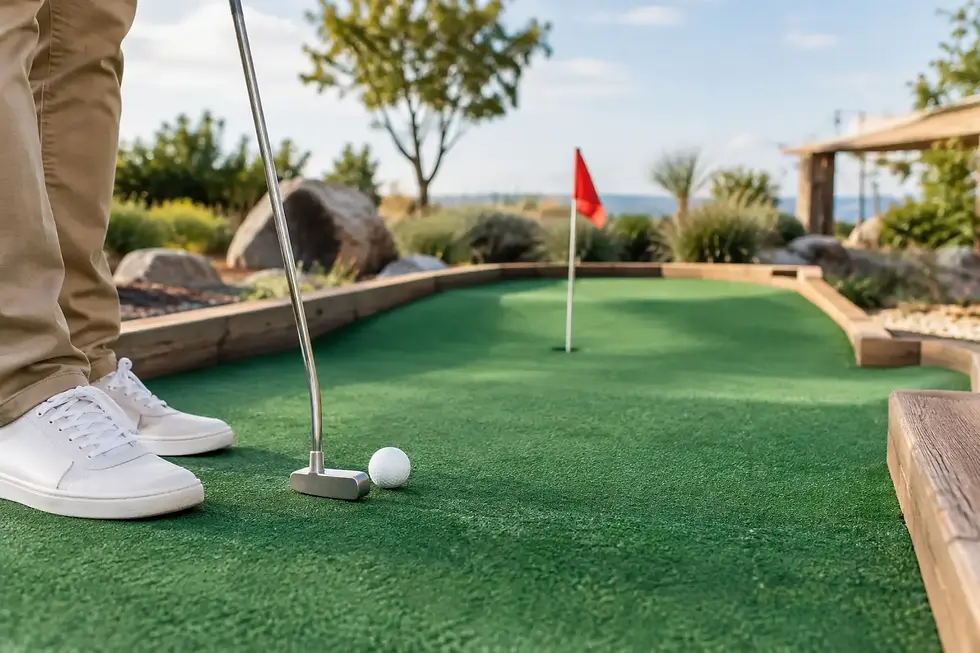
Mini golf is one of the most reliable choices because it gives strangers something to do side by side. A missed putt, an ambitious shot or a friendly score challenge provides an instant talking point, without placing anyone on the spot.
It works especially well at drinks receptions, company parties and exhibition stands because guests can play a hole or two and move on. A portable course also adds colour and movement to the room, helping your networking area feel more inviting than a row of tables and name badges. Putting Edge can tailor course sizes and themes to suit anything from a compact indoor reception to a larger corporate event.
2. Networking bingo
Networking bingo replaces numbers with prompts such as “has launched a new product”, “speaks more than one language” or “has attended this event before”. Guests find people who match each square and note their names.
This game gives attendees a clear opening line and encourages conversations beyond job titles. Keep prompts positive and relevant to the audience. For a business conference, include professional experience; for a team social, add a few lighter interests.
3. Conversation card stations
Place a small set of question cards on high tables, near refreshments or beside an activity. Prompts might ask which business problem people most want to solve this year, what makes an event memorable, or which skill they would most like to learn.
Cards are best for audiences that value meaningful discussion but may need a gentle nudge to begin. They are inexpensive, flexible and easy to brand, although they work better as a supporting feature than the main attraction.
4. Speed networking rounds
Speed networking gives guests a timed format for meeting several people. Pair attendees for three to five minutes, then invite one side of the room to rotate. A visible timer and one suggested question per round keep it moving.
This format is useful when the event has a clear business purpose, such as supplier introductions or industry meet-ups. It can feel too structured for a relaxed party, so build in free networking time before and afterwards. People often want to return to the most promising conversations without watching the clock.
5. Themed photo challenge
Create a short photo challenge that asks small groups to capture details around the venue, complete playful prompts or recreate a themed pose. At a trade show, prompts could include visiting a set number of stands or finding a product that solves a particular challenge.
A photo challenge gets people moving and collaborating quickly. Keep it optional and make sure every task can be completed without sharing personal images publicly. The best version is lively but not distracting from the event’s main purpose.
6. Two truths and a lie
This familiar icebreaker still earns its place when it is used in small groups rather than announced to a whole room. Each person shares three statements and the group guesses which one is false.
It is simple, funny and surprisingly good at revealing common ground. Ask guests to keep statements workplace-appropriate and avoid making anyone disclose something they would rather keep private. A host can introduce it at tables during dinner or in a quieter breakout area.
7. The common-ground challenge
Give groups of four or five minutes to find three things they all have in common that are not obvious from their work or appearance. They might discover a shared hobby, a favourite city or a mutual love of a particular sport.
This is an excellent choice for mixed groups because it moves the conversation beyond roles and organisations. It is also quick enough to use at the beginning of a workshop before people work together on more formal tasks.
8. Tabletop quiz rounds
A short quiz can bring people together without taking over the event. Use rounds linked to your organisation, industry, local area or a fun theme. Teams of four to six are ideal, particularly if you invite guests to join people they have not met yet.
Keep the questions accessible. A networking quiz should create discussion and laughter, not reward one person for knowing obscure facts. One or two rounds are usually enough before returning the room to open conversation.
9. Prize draw passport
For exhibitions and larger venues, give attendees a card or digital passport to collect stamps after speaking with selected exhibitors, joining a demonstration or trying an activity. Completed passports can enter a prize draw.
This encourages movement and helps sponsors receive genuine visitor interest. The trade-off is that it needs careful planning. Make the route feel worthwhile rather than turning every conversation into a transaction, and offer a prize that suits the audience.
10. Build-it-together challenges
Quick construction challenges using everyday materials can be surprisingly effective. Small groups might build the tallest free-standing structure from paper and tape, or design a bridge that supports a small object.
These activities are ideal for team-building events where collaboration matters as much as conversation. They are less suited to a drop-in reception, where guests may not have time to complete a task. Give clear time limits and celebrate creative approaches, not just the winning team.
11. Business card match-up
Instead of asking guests to hand over their own business card, provide cards featuring broad skills, business needs or industry themes. Guests find someone whose card complements theirs, then discuss how they might work together.
This is a more purposeful alternative to generic mingling, particularly for professional associations and supplier events. Keep categories broad enough that people can interpret them in their own way. Nobody should feel boxed into a label.
12. Charity putting challenge
A putting challenge adds a feel-good reason to take part. Guests make a small donation or earn points for a chosen charity based on their score, with a leaderboard adding friendly momentum throughout the evening.
This works brilliantly for fundraising dinners, client events and office celebrations. It offers all the social benefits of mini golf while giving the activity an extra purpose. Just make the scoring easy to follow and ensure there is no pressure to donate.
Match the game to the moment
The best choice depends on how your event will flow. For a drop-in drinks reception, activities such as mini golf, conversation cards and a photo challenge let guests participate at their own pace. For a conference or business breakfast, speed networking and networking bingo create useful structure. For an exhibition, a passport challenge can encourage guests to explore without making the experience feel overly formal.
Think about your venue as well. A large course can become a real focal point in an open event space, while one or two mini golf holes can bring the same playful energy to a smaller room. Consider noise, available floor space, guest numbers and whether people will be carrying drinks, laptops or exhibition materials.
Make participation feel effortless
How you introduce an activity matters as much as the activity itself. Position it where guests can see it, explain the rules in one clear sentence and have a friendly host nearby for the first few minutes. If people need to register, download something or wait in a long queue, many will simply keep chatting with colleagues instead.
Offer a reason to join, but do not make it compulsory. A small prize, a charity element or a leaderboard can encourage participation, yet the real reward is a room where conversation starts naturally. Give guests permission to play, laugh and move between groups.
A well-chosen game turns the nervous first five minutes of an event into the part people remember. Choose something inclusive, easy to join and genuinely enjoyable, then let the conversations do the rest.


Comments