


Corporate Mini Golf Case Study for Better Events
The toughest part of planning a company event is rarely filling the room. It is giving people a reason to talk, stay involved and leave with a positive memory of the occasion. This corporate mini golf case study looks at how a portable course can turn a familiar corporate gathering into a genuinely social experience, without adding a complicated activity for the organiser to manage.
The brief: create a buzz without excluding anyone
A Surrey-based business was arranging an annual staff and client event for around 120 guests. The venue had a smart reception space, a drinks area and room for food, but the team wanted more than background music and polite small talk. They needed an activity that would help colleagues from different departments mix with visiting clients, while still fitting the professional setting.
The organiser had three clear requirements. The entertainment had to be suitable for a mixed group of ages and confidence levels, easy to understand without a long briefing, and flexible enough to work around speeches, catering and arrivals. Competitive activities such as a quiz or team challenge were considered, but they risked leaving quieter guests on the sidelines or demanding everyone’s attention at one fixed time.
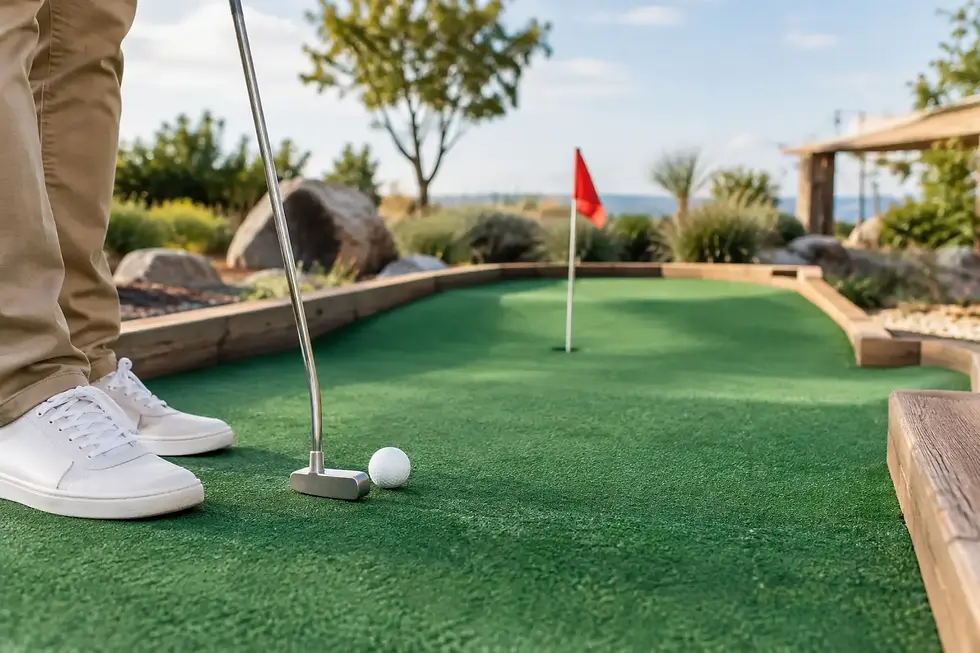
Portable mini golf offered a better fit. Guests could play for five minutes or fifty, join a group halfway through, or simply cheer on a colleague with a drink in hand. There was no pressure to perform, and no need for specialist skills. That matters at a corporate event, where the best entertainment brings people together rather than dividing the room into keen participants and spectators.
Corporate mini golf case study: planning the course
The event team chose a nine-hole course rather than an 18-hole layout. This gave guests plenty to do while leaving clear space for food service, informal seating and a presentation area. A full 18-hole course can be a brilliant centrepiece for a larger venue or all-day event, but a smaller format was the right choice here because it protected the flow of the evening.
Before the event, the hire provider reviewed the venue access, available floor space and timings. This step is easy to overlook, yet it is where a good idea becomes a stress-free attraction. The course needed to be installed before guests arrived, positioned away from busy entrances, and arranged so that players did not block the bar or catering team.
The organiser also wanted the activity to look at home in the venue rather than like an afterthought. A clean, professionally presented course matched the relaxed but polished atmosphere. For a brand launch or exhibition stand, the same principle could mean choosing a themed course, branded scorecards or holes arranged around a campaign message. For this staff and client event, the priority was sociable fun with a smart finish.
Why nine holes made sense
A nine-hole course reduced waiting times and encouraged guests to return throughout the event. Small groups formed naturally: a client joined a pair of colleagues, a manager challenged a new starter, and people who had never met found an immediate talking point.
This is one of mini golf’s greatest strengths at corporate occasions. It gives conversations somewhere to go. Instead of relying on a formal networking prompt, guests have a shared, low-stakes challenge in front of them. The missed putt, near miss or unexpected hole-in-one does the ice-breaking for you.
What happened on the day
The course was ready before the first guests arrived. As the room filled, people gravitated towards it without needing an announcement. Early players set the tone, and within the first hour there was a steady rotation of groups around the holes.
The activity worked particularly well during the arrival period, when guests were filtering in at different times. Rather than waiting awkwardly for everyone to arrive or for the first speech to begin, they had something easy and enjoyable to do. It also gave the host team a useful way to welcome people: grab a putter, choose a ball and have a go.
Once food was served, the course remained active without taking over the event. Some guests played a full round, while others picked out one or two holes between conversations. This flexible participation is a major advantage over entertainment that runs to a timetable. Nobody felt they had missed their chance because they were speaking to a client, taking a call or arriving late.
A friendly leaderboard added momentum later in the evening. The prize was deliberately light-hearted, keeping the focus on fun rather than turning the activity into a serious contest. For some company cultures, a more structured team tournament can work well. For this group, an informal individual scorecard created just enough competitive spirit.
The results that mattered
The organiser’s aim was not simply to keep guests occupied. They wanted the event to feel warmer, more interactive and worth attending. By that measure, the course delivered.
Colleagues who would not usually work together spent time in mixed groups. Clients had a natural way to engage with the team outside formal business conversation. Guests who were less interested in dancing or loud entertainment still had a focal point they could enjoy. The mini golf course became a visual feature in the room and a source of laughter throughout the evening.
It also helped the organiser in a less obvious way: it made the event feel well planned. A portable course provides a clear activity without creating extra jobs for the internal team. With delivery, set-up and takedown handled professionally, the organiser could focus on guests, timings and the wider event rather than managing equipment.
The outcome will look different for every business. A sales conference may use mini golf to draw delegates into a break-out area. A trade show may use it to start conversations with visitors. A summer party may turn it into a team competition. The common thread is participation. When people can join in quickly and on their own terms, the energy of the event changes.
Lessons for corporate event organisers
The right mini golf setup depends on your space, audience and objective. A compact course suits a reception, office party or venue with limited room. A larger 18-hole layout creates more of a destination attraction and can be ideal for a company fun day, exhibition or family-inclusive celebration.
Think about timing as well as floor space. If guests need a gentle way to settle in, have the course ready from arrival. If you want a big reveal after dinner, make it part of the evening programme. For an exhibition, place it where it can catch the eye without obstructing footfall. The best position is visible enough to attract interest but practical enough to keep the event moving.
It is also worth deciding how competitive you want the experience to be. A leaderboard and prize can encourage repeat play, while an unscored course feels more relaxed. Neither option is better in every situation. It depends on whether you are building team spirit, encouraging networking or simply giving guests something memorable to enjoy.
Make the activity fit the occasion
Mini golf is at its best when it feels like part of the event, not an add-on. For a summer celebration, a tropical island course can bring a playful holiday feel. For a themed party, a pirate course gives guests an instant visual talking point. For a formal client evening, a classic course with simple scoring may be the better match.
Putting Edge can help organisers choose a course size and format that works for the venue, guest numbers and event schedule. That early conversation can prevent common problems, such as choosing too many holes for the available space or placing the attraction where queues build up.
A successful corporate event does not need every guest doing the same thing at the same time. It needs moments that make people feel included. Give them a putter, a ball and a reason to laugh together, and the conversation often takes care of itself.


header.all-comments