


How Does Mini Golf Work at Events?
- Oliver Naimsith
- May 7
- 6 min read
If you are wondering how does mini golf work, the short answer is this: players take turns putting a golf ball through a short, themed course, aiming to get the ball into each hole in as few shots as possible. The reason it works so well at events is even simpler. It is easy to understand, quick to join, and fun for guests who may never have picked up a golf club before.
That matters when you are planning a wedding, party, corporate event or exhibition stand. You want entertainment that feels interactive without becoming complicated. Mini golf hits that sweet spot. It gives people something to do, something to chat about and something that suits mixed age groups, all without needing a full sports setup or a lot of instruction.
How does mini golf work in practice?
At its core, mini golf follows the same basic idea as traditional golf, but on a much smaller scale. Instead of driving a ball across a large course, players use a putter to guide the ball around compact holes with obstacles, corners, ramps or themed features. Each player starts at the first hole and tries to sink the ball in as few strokes as possible before moving on to the next.
Every stroke counts towards the final score. The player with the lowest total at the end wins. That is one reason mini golf has such broad appeal. The rules are simple enough for children, but there is still enough skill and friendly competition to keep adults interested.
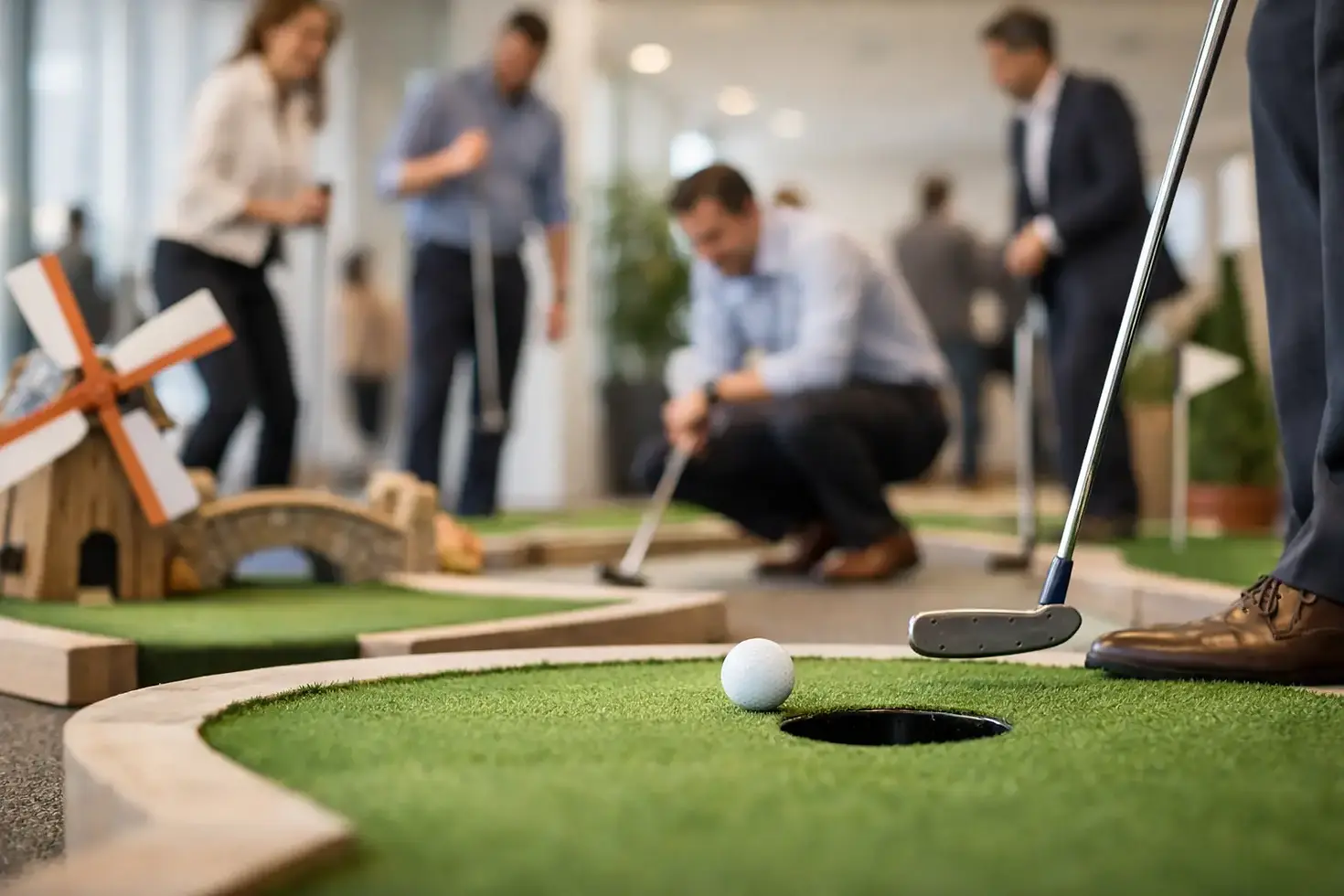
For events, the format is especially flexible. You might have a single feature hole for a trade show stand, a few holes dotted around a venue for a drinks reception, or a full 9-hole or 18-hole setup for guests to enjoy throughout the day. It can be as relaxed or as competitive as you want it to be.
The basic rules guests need to know
Most people can start playing within minutes. Each player takes a turn from the designated starting point on the hole. They continue putting until the ball drops into the cup, then note their score and move on.
There are usually a few house rules depending on the course design, but the common ones are straightforward. If a ball goes off the playing surface, it is placed back where it left the hole or at a marked spot. If a ball hits an obstacle and bounces back, the player simply plays it from where it stops. Some organisers also set a maximum number of shots per hole to keep the game moving.
That simplicity is a big advantage at events. Guests do not need a staff briefing or specialist knowledge. They can watch one group play and immediately understand how to join in.
What equipment is used?
Mini golf needs very little to get going. Players use a putter, a golf ball and a scorecard if scoring is part of the experience. The course itself is made up of individual holes, each with its own putting lane and features.
With portable mini golf, the setup is designed to work in event spaces rather than permanent leisure venues. That means the holes can be installed indoors or outdoors, depending on the venue and conditions. For organisers, this is a major plus. You get the attraction and visual impact of mini golf without needing a dedicated course built into the site.
How scoring works
Scoring is one of the easiest parts to understand. One putt equals one point. If a player takes three shots to complete a hole, they score three for that hole. Add up every hole at the end, and the lowest score wins.
For some events, formal scoring adds a competitive edge. That works particularly well for team building days, staff socials and brand activations where a leaderboard can keep energy levels up. At other events, especially weddings and family parties, guests often play casually without worrying too much about totals. Neither approach is wrong. It depends on the atmosphere you want.
Why mini golf works so well for events
A lot of entertainment looks good on paper but becomes awkward in the room. It takes too long to explain, only appeals to one age group, or creates queues that put people off. Mini golf usually avoids those problems.
First, it is inclusive. Children can play, adults can play, and guests do not need to be sporty to enjoy it. That makes it ideal for occasions where your guest list is mixed and you want something with broad appeal.
Second, it is naturally social. People gather around a hole, laugh at near misses and cheer on a lucky shot. Even guests who are not playing straight away still get drawn into the activity. That helps break the ice, which is useful at corporate events, exhibitions and weddings where not everyone already knows each other.
Third, it is adaptable. A portable course can be matched to the size of your venue, the flow of your event and the style you want to create. A polished indoor setup can suit a formal reception just as easily as a brightly themed course can lift a birthday party or family fun day.
What happens when you hire portable mini golf?
This is where event mini golf differs from visiting a permanent mini golf venue. Instead of asking guests to travel to the activity, the activity comes to you.
A professional provider will usually start by understanding the event type, venue size, guest numbers and the sort of experience you want. From there, they can recommend the right number of holes and a setup that fits the space properly. That might mean a compact course for a smaller venue or a larger installation for a bigger crowd.
On the day, the course is delivered, assembled and arranged to suit the layout. Once it is in place, guests can play throughout the agreed hire period. After the event, everything is taken down and removed. For organisers, that full-service approach is often the real selling point. You get a high-impact activity without taking on extra logistics yourself.
This is one reason portable mini golf has become so popular for weddings, office parties, trade shows and private celebrations. It offers the fun of a game with the convenience of a managed hire service.
How does mini golf work for different occasions?
The basics stay the same, but the way mini golf is used can vary quite a lot depending on the event.
At weddings, it often works best as relaxed entertainment during the drinks reception or evening. Guests can play casually while photographs are being taken or while different groups mingle. It gives people a reason to move around and interact, especially helpful if families and friendship groups are meeting for the first time.
At corporate events, mini golf can be more structured. Teams might compete for the best score, or the course might be branded and used as a talking point at a launch or exhibition. It is a good option when you want something more memorable than passive entertainment but still easy to slot into a busy schedule.
For birthday parties and family celebrations, the appeal is obvious. It is colourful, easy to join and suitable for both children and adults. You do not need everyone to be at the same skill level for it to work.
Things that can affect the experience
Mini golf is straightforward, but a few practical factors make a difference. Space matters. A course should feel inviting, not squeezed into awkward corners. Good layout planning helps guests circulate comfortably and keeps the game enjoyable.
Guest numbers matter too. A very large event may need more holes or a format that spreads people out. Otherwise, you risk bottlenecks. On the other hand, a smaller event does not always need a full 18-hole course. Sometimes a shorter setup creates a better fit and keeps the activity feeling lively.
If the event is outdoors, weather is another consideration. Portable mini golf can work brilliantly outside, but it is worth thinking about level ground and a backup plan if conditions change. A good provider will talk that through with you in advance rather than leaving you to guess.
Is mini golf competitive or just for fun?
The answer is both, and that is part of its charm. Some guests will absolutely want to win. Others will simply enjoy having a go. Mini golf handles both types of player without making either feel out of place.
That balance is especially useful for event organisers. You can keep things light and informal, or you can build in prizes, scoreboards and team play if you want more structure. A company like Putting Edge can help shape that around your event rather than forcing you into a one-size-fits-all format.
If you want entertainment that feels easy for guests and easy for organisers, mini golf earns its place. It starts with a putter and a ball, but what it really creates is a shared moment people remember after the event has finished.


Comments