


Brand Activation Games That Get People Talking
A busy exhibition hall gives visitors plenty to look at and very little reason to stop. Brand activation games change that. A well-chosen game creates a natural pause in the crowd, gives people a reason to approach your stand and makes the first conversation with your team feel far less formal.
For marketing teams, event planners and exhibitors, the aim is not simply to hand out prizes or fill spare space. The best activations make your brand easier to remember because guests have actively spent time with it. Portable mini golf does this particularly well: it is instantly familiar, easy to join and fun for a broad mix of ages and abilities.
Why brand activation games work at live events
People remember what they do more readily than what they are told. At a trade show, product launch or corporate event, a game gives your visitors a small challenge, a moment of friendly competition and a reason to linger. That extra time can turn a passing glance into a useful conversation about your product, service or campaign.
Games also make a stand feel approachable. Not every visitor wants to be the first person to start a sales conversation, especially in a busy room. A putting challenge offers an easy opening: take a shot, compare scores and chat while waiting for the next turn. Your team can then engage naturally, rather than relying on a rehearsed pitch.
There is a practical benefit too. An interactive attraction creates visible movement and interest. When people see others taking part, they are more likely to come over and find out what is happening. The experience becomes part of the draw, helping your space stand out from rows of banners, brochures and screens.
What makes a game right for your brand?
The most successful brand activation games are simple enough to understand in seconds. If visitors need a long explanation, special skills or too much time, many will keep walking. A short mini golf hole is ideal because the goal is clear, each turn is quick and anyone can have a go.
Your activity should also suit the type of event and the audience you expect. A competitive leaderboard can work brilliantly at a staff fun day or sports-focused campaign. At a networking event, a relaxed putting experience may be the better choice, giving guests something social to do between conversations.
Think about the feeling you want people to leave with. A playful tropical island course can add colour and holiday energy to a summer promotion. A pirate-themed setup may suit a family-friendly event or a campaign that needs a sense of adventure. For more formal corporate occasions, a smart, professionally presented course can still bring the fun while fitting the venue and brand setting.
Use mini golf to create a memorable brand moment
Mini golf has a rare advantage in event marketing: people already know how it works. There is no barrier to entry, and guests do not need to download an app, wear specialist equipment or commit to a lengthy activity. They can pick up a putter, take their shot and join the fun straight away.
That simplicity does not mean the activation has to feel generic. A course can be tailored around the available space, from a single-hole putting challenge at a compact stand to a larger multi-hole experience for an exhibition, conference or outdoor event. Branded scorecards, signage, prizes and themed decorations can help tie the game to your wider campaign.
The key is to keep branding present without getting in the way of the game. Visitors should feel they are enjoying an experience, not completing a sales task. A subtle logo at the tee, a campaign message on the scorecard or a prize linked to your service is often more effective than covering every surface with promotional text.
Keep the challenge short and sociable
At a trade show, throughput matters. A single-hole challenge means more people can participate, while a leaderboard gives them a reason to return later and see whether their score has been beaten. It also gives your team a useful excuse to collect contact details, provided entry is clearly optional and any data is handled appropriately.
For a client event, company celebration or launch party, a longer course can encourage guests to mingle. Groups naturally form around each hole, sharing tips, cheering good shots and laughing at near misses. It works especially well where the guest list includes different departments, clients or age groups who may not otherwise know each other.
Make prizes support the experience
A prize can add excitement, but it does not need to be expensive to work. A daily winner, a lucky draw for everyone who takes part or a small branded gift can be enough. The most useful prizes relate to your audience and reinforce your campaign rather than distracting from it.
It is worth avoiding rules that are too complicated. A straightforward nearest-the-pin-style putting challenge, best score of the day or prize draw is easy to explain and easy for guests to remember. Your staff should spend their time welcoming people and starting conversations, not resolving score disputes.
Plan for the practical details
A brilliant idea still needs to work in the venue. Before choosing an activation, consider the floor space, access times, footfall and whether the activity will be indoors or outdoors. You will also want to leave enough room for queues without blocking walkways or neighbouring exhibitors.
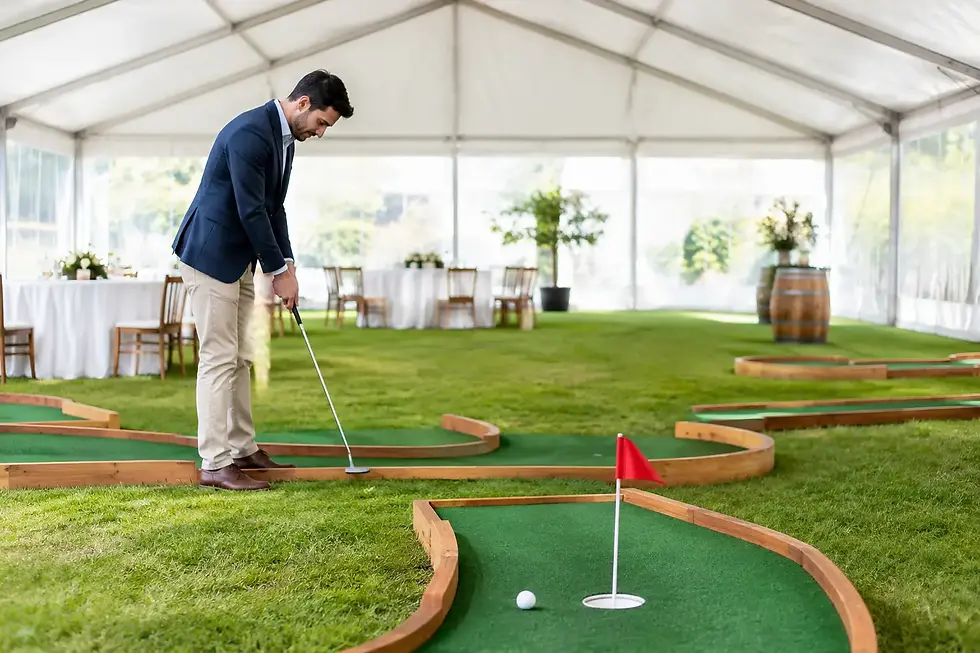
Mini golf is a flexible option because courses can be selected to suit the setting. A small footprint may be all you need for a focused challenge, while a larger event can accommodate a fuller course as a centrepiece. Professional setup and takedown remove a significant job from your event schedule, leaving your team free to focus on the campaign itself.
Staffing is another decision that depends on your objective. If your priority is lead generation, have friendly team members nearby who know what to ask once a visitor has finished their turn. If the goal is brand awareness or guest entertainment, a clear sign, simple instructions and a welcoming host may be all that is required.
Accessibility should be considered from the start. Keep the play area clear, avoid creating awkward pinch points and make it easy for guests to watch or take part at their own pace. An inclusive activity is more likely to attract a wider audience and create the welcoming atmosphere your brand wants to project.
Measure more than footfall
A queue can be encouraging, but it is not the only sign of a successful activation. Decide in advance what you want the game to achieve. It might be more conversations with potential clients, email sign-ups, social content, product demonstrations booked or simply a stronger experience for guests at an internal event.
Simple measures are usually the most useful. Track the number of participants, the number of meaningful conversations and how many people choose to share their details. Ask your team what questions visitors raised most often. Those insights can help you improve the next event as much as the raw numbers do.
Photos and short videos can also extend the value of the activation, particularly when the course has a strong visual theme. Always make sure your approach to photography is appropriate for the event and venue, but cheerful gameplay gives you far more engaging material than another picture of an empty stand.
Give visitors a reason to stay
The right game does more than entertain people for a few minutes. It gives your brand a friendly, human way to begin a relationship. Whether you need a quick putting challenge for a busy exhibition stand or a full course for a larger company event, the experience should feel easy to join, enjoyable to share and professionally organised.
A portable mini golf course from Putting Edge can be shaped around your venue, audience and campaign, with setup and takedown handled for you. Choose an activity that makes people smile first, and the conversations you want are much more likely to follow.


Comments